





2026-11-25
NIO Showcases Its Latest Innovative Technologies at NIO IN 2026
November 25, 2026, Guangzhou China - Marking its 12th anniversary, NIO hosted the third NIO IN, its innovation and technology event, in Guangzhou. At the event, NIO unveiled NIO WorldModel (NWM) 3.0 and NOMI Intelligence 4.0, and announced the rollout plans for both technologies. The Company also shared its latest progress in building an AI-native organization and AI-powered smart power network.
Faster Response, More Efficient Training
NWM 3.0 Launched
Since its debut in July 2024, NWM has evolved through three iterations. NWM 3.0 represents NIO’s latest exploration into scaling physical intelligence for smart driving.
Shaoqing Ren, NIO’s Senior Vice President and Head of Autonomous Driving Development, presented NWM 3.0’s breakthroughs in latency reduction, efficient compute utilization, and decision-making in complex driving scenarios.
For onboard processing, NWM 3.0 introduces 4D spatiotemporal compression using tubelet-based spatiotemporal encoding. This enables the model to capture subtle changes in road conditions while achieving a 36-fold reduction in onboard computing resources required for attention, significantly improving onboard computational efficiency and responsiveness. Through coordinated optimization of algorithms, chips, and chassis control at the vehicle level, NWM 3.0 further reduces chassis control latency by 78% and overall vehicle control latency by 54%.
During training, NWM 3.0 employs a reinforcement learning framework with two closed loops, one in observation space and the other in latent space. The latter updates world representations with greater speed and less resource consumption, while the former reconstructs and generates sensor observations to enhance the reliability of closed-loop testing. As a result, overall training efficiency is five times that of its predecessor. NWM 3.0 also introduces a reward model, enabling more dynamic evaluation in real-world conditions. Compared with the previous generation, NWM 3.0 requires 40% fewer driver interventions, boosting users’ sense of reassurance by around 60%.
NWM 3.0 marks a new milestone in NIO smart driving. Starting in December, NWM 3.0 will be rolled out to all users of Banyan, Cedar, Cedar S, and Coconut+ smart systems upon regulatory filing and clearance.
A New Era of Emotional Intelligence
NOMI Intelligence 4.0 Unveiled
The evolution of vehicle intelligence is reflected not only in how a vehicle perceives and responds to the world around it, but also in how people interact with it from within. For 12 years, NOMI has pioneered emotional intelligence through three generations. Today, NIO opens a new chapter with the official launch of NOMI Intelligence 4.0, an all-scenario emotional intelligence system designed for the vehicle.
Conventional in-car voice assistants have largely been limited to executing commands through predefined workflows. With Intelligence 4.0, NOMI completes a fundamental architectural transformation, integrating NIO’s foundation model portfolio, native AI Agent framework, underlying infrastructure, and vehicle-wide safety framework. NOMI now is able to perceive its surroundings both inside and outside the vehicle, orchestrate tools across vehicle systems, and understand user intent, plan actions, and accomplish tasks based on set goals.
NIO’s Senior Vice President of Product Experience, Ted Li, unveiled two major technological advances that underpin the new architecture: a proprietary foundation model matrix with dedicated in-vehicle reinforcement learning, which takes NOMI’s intelligence to new heights; and the industry’s first vehicle-native intelligent agent framework, which empowers NOMI to perceive its environment, call on tools, make independent decisions, and act autonomously.
The new architecture redefines how NOMI operates, taking it beyond simply following commands to independently understanding goals, planning, and executing tasks. Integrating the foundation model matrix and intelligent agent framework with the vehicle’s underlying system architecture and safety mechanisms, and building on a fully in-house, end-to-end technology stack, NOMI Intelligence 4.0 is poised to drive the next wave of technological advancement across the industry.
NOMI is always getting better. With NOMI Intelligence 4.0, it will become smarter, more intuitive, and more in tune with you.
NIO will introduce NOMI Intelligence 4.0 across its smart systems in phases. The rollout with Cedar 2.0.0, the first release to feature NOMI Intelligence 4.0, will be filed in early December this year and start after clearance. Models running Cedar S and Banyan smart systems are expected to receive the update in the second quarter of 2027, following system adaptation. The technology will later be extended to the Coconut and Coconut+ systems of ONVO models.
Building an AI-Native Organization
William Li, Founder, Chairman, and CEO of NIO, shared the Company’s thinking and progress in building an AI-native organization.
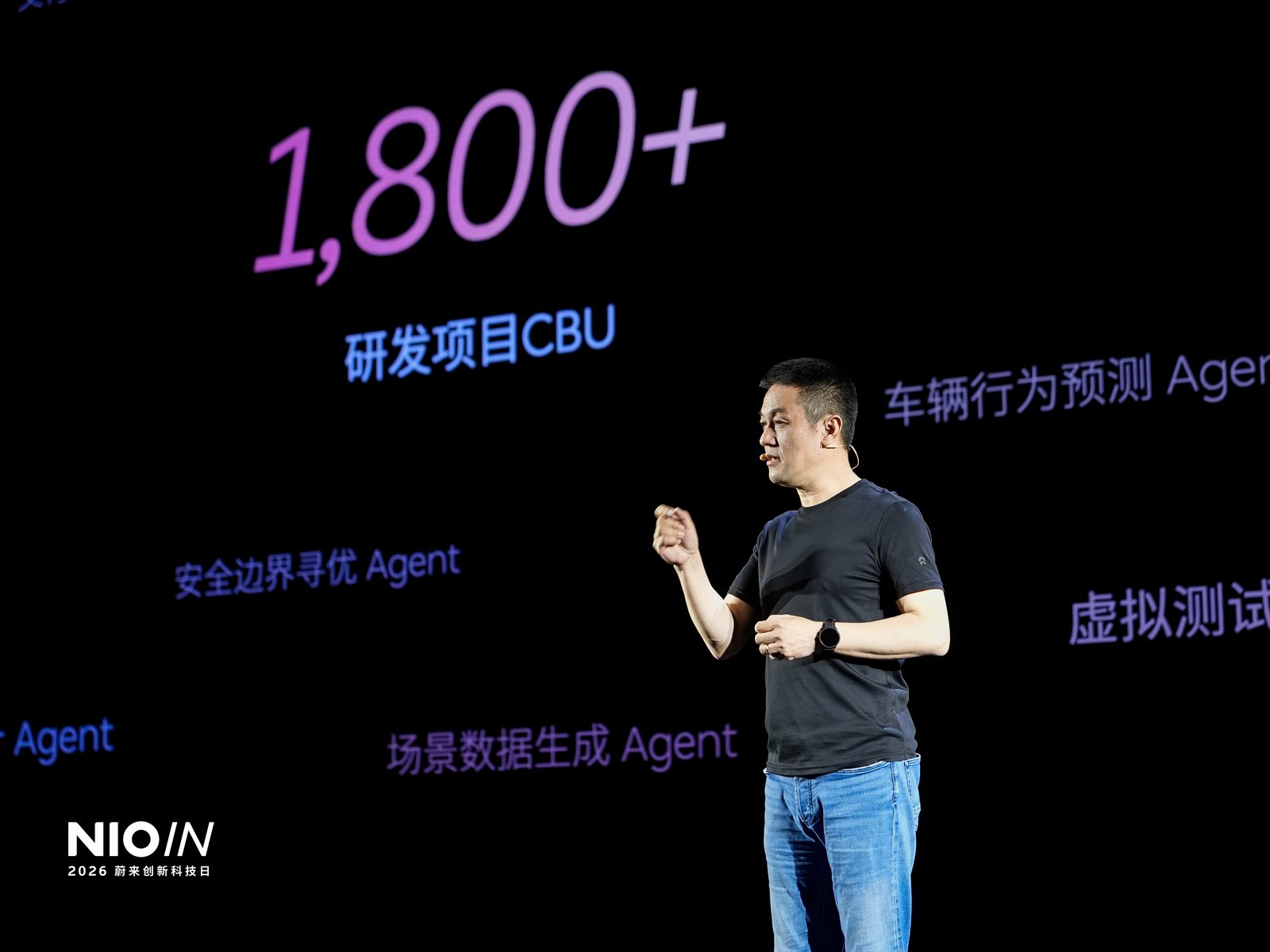
He noted that smart electric vehicles represent the most valuable form of physical AI, and the automotive industry is the largest sector for AI application. Spanning components, vehicle manufacturing, sales, service, energy, and financial services, the global automotive industry is worth approximately USD 7 to 9 trillion. If AI can generate 15% more value across the industry, it could unlock more than USD 1.2 trillion in additional commercial value.
According to Li, automobiles are a key vehicle for bringing AI into the physical world. Automakers themselves must also become AI-native organizations, embedding AI into their business operations. The shift will be critical to staying competitive and driving the next wave of transformation.
Since 2023, NIO has been advancing organizational transformation and building its AI system capabilities. Centered on 12 categories of Cell Business Units (CBUs), including users, vehicles, R&D projects, components, batteries, and charging and swapping stations, NIO has progressively defined how each business unit creates value, its business accountability, capability requirements, and collaborative relationships. Building on the CBU mechanism, NIO has integrated enterprise AI technologies to establish a six-layer AI-native CBU operating architecture for user value creation.
Today, AI is being applied across multiple business areas at NIO, including R&D, manufacturing, logistics, and user services. More than 7,500 AI agents have been deployed, with over 2.9 million executions to date. AI is becoming increasingly integral to NIO’s day-to-day business operations.
NIO CFO and Head of NIO Power Stanley Qu shared how NIO Power is putting the CBU model into practice. As one of the first business units within NIO to adopt this model, NIO Power is a leading example of how AI can be deeply embedded in business operations to manage a complex energy network more efficiently. With batteries as well as charging and swapping stations as its two core CBUs, NIO Power leverages multiple AI agents to optimize asset value, user experience, and energy efficiency.
By 2030, NIO Power expects to manage more than RMB 350 billion in battery assets, operate over 10,000 Power Swap Stations, and deliver more than 10 billion kWh of energy annually through charging and battery swapping. NIO Power’s AI-native approach centers on organizing data around its CBUs, translating operational capabilities into models, and empowering business teams through AI agents. Real-world business outcomes, in turn, feed back into the continuous improvement of data, models, and processes. This AI-native organization is already generating tangible user value and business returns, enabling more granular management of every battery and every station, bringing NIO Power closer to its vision of making recharging as convenient as refueling.
For William Li, smart EVs have been at the forefront of technological innovation for more than a decade. Now, as AI reshapes the industry, smart EVs are entering a new phase of technological breakthroughs, which will fundamentally transform the smart driving and smart cabin experience.
The latest technologies unveiled at this year’s NIO IN: NIO WorldModel 3.0 and NOMI Intelligence 4.0, mark NIO’s latest advances in these two areas. NWM 3.0 helps vehicles better anticipate changing road conditions and respond faster. NOMI Intelligence 4.0 takes in what users want to achieve, draws on the vehicle-wide capabilities, and gets things done. As these technologies roll out, users will experience the difference firsthand, both on the road and inside the cabin.
About NIO
NIO is a global smart electric vehicle company founded in November 2014. Dedicated to shaping a sustainable and brighter future together by providing high-performance smart electric vehicles and exceptional user experiences, NIO is the first car company listed on the NYSE, HKEX and SGX. NIO currently has three major brands under its umbrella: NIO, ONVO and firefly.
Ten years into establishment, NIO is now one of the leading companies in the global premium smart electric vehicle market, committed to fostering its own research and development capabilities for core technologies, the company had filed for and obtained over 13,000 patents. Additionally, NIO has developed NIO Full Stack, a collection of 12 technology domains.
Currently, NIO has R&D centers and manufacturing facilities in over 10 locations, including Shanghai, Hefei, Beijing, Nanjing, San Jose, Munich, Oxford, Budapest, Singapore, and Abu Dhabi. Additionally, it has built a sales and service network across 24 countries and regions, including China, Europe, the Middle East, Central Asia, Southeast Asia, and Central America.
NIO Inc. currently offers eight premium smart electric vehicle models under the NIO brand, two smart electric vehicle under the ONVO brand and one small, smart, high-end electric vehicle under firefly brand. As of October 31, 2026, NIO Inc.’s cumulative deliveries reached 1,332,139 vehicles, reinforcing its position as a leader in advancing technological innovation and premium brand development in China’s smart EV industry.
